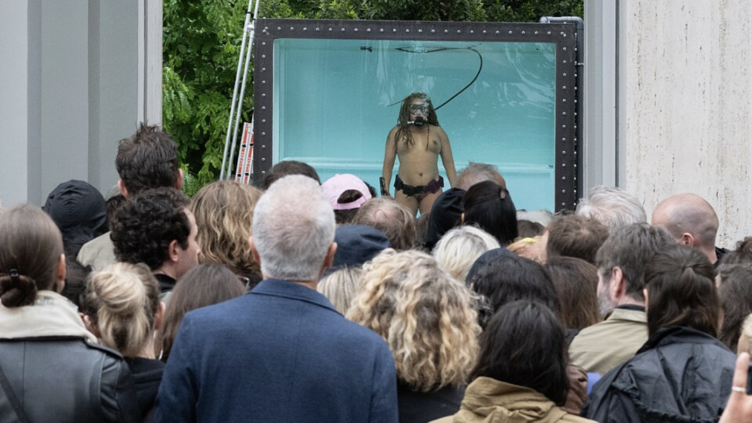
Queer artists were everywhere to be found at the 2026 Venice Biennale, In Minor Keys, but it was unclear what precisely they were meant to be saying. Or, perhaps, they were saying everything but queer itself. No longer screaming a self-referential and marketable identity category, a select group of artists at Venice this year are responding to the contemporary transition from millennial liberalism to conservative nationalism. They deploy queerness instead as an aesthetic field that addresses the political economy of the present.
Of course, artists of marginalized sexualities and gender identities have long exhibited at the Venice Biennale, openly or otherwise. Gay politics had already entered the Biennale’s institutional orbit by 1977, when its Biennale of Dissent became a site of protest over Sergei Parajanov’s imprisonment on charges that included homosexuality; in 1990, Gran Fury brought AIDS activism and gay sexual politics directly into Aperto ’90.1 But queer as an explicitly named curatorial and identitarian designation has a much more recent lineage, one that has informed a somewhat circumscribed, sellable category of art. Elmgreen and Dragset’s 2009 installation, “The Collectors,” in the Nordic Pavilion, explicitly described some of its artworks as “queer-related.” More recently, the 2022 Venice Biennale, The Milk of Dreams, included a markedly wide range of work by queer artists, including Zheng Bo, Wu Tsang, P. Staff, Sidsel Meineche Hansen, and Marianna Simnett. The Biennale’s accompanying program also included “The Queer and the Eerie,” a conversation expressly addressing “the politics of queerness.”
Adriano Pedrosa’s 2024 Biennale, Foreigners Everywhere, presented an apex of sorts for this trajectory. Notable works ranged from the gestural emerald tableaux of Salman Toor to the potently tender erotic paintings of Louis Fratino. Public sex and cruising also made expected appearances, including in porn-cinema photographs by Miguel Ángel Rojas and Dean Sameshima. A sizable section in the Central Pavilion was devoted to abstraction by queer artists.
But if the 2024 Biennale foregrounded queerness, and the queer artist, as an organizing schema, the 2026 iteration marks a shift away from this framework, as well as from the often earnest and overtly carnal work within it. This friction emerges in the tension between national identification and queer disidentification in the Swiss and Japanese pavilions. “The Unfinished Business of Living Together,” the Swiss pavilion’s collective presentation, takes as its title an acknowledgment of the ongoing, unresolved question of queerness’s relation to national belonging. Structured around televised debates from the 1970s and 80s about homosexuality in Swiss public life, the artist-curatorial team positions archival film footage in dialogue with newly produced material.
A selection of other works presents a plurality of queer identities and forms of visibility in Switzerland’s recent history, including Alice Arnold’s photographs of cross-dressing protests in Zurich and Nina Wakeford’s “Reopening Bar Jeder Frau,” which reworks Katrin Barben’s 1991 short film of a lesbian bar to include contemporary figures. Much is reperformed, both literally and figuratively, in this timely but somewhat overloaded installation. But some architectural-spatial components of the installation, including elements of civil-defense shelters and a door from the Swiss consulate in Venice, risk overdetermining a tension that the television work conveys more nimbly.
A more focused, and tonally complex, examination of queerness’s relationship to national and societal belonging appears in Ei Arakawa-Nash’s installation for the Japanese national pavilion, “Grass Babies, Moon Babies.” Relating national anxieties around population decline and stagnation to the artist’s own journey as a queer parent of twins, Arakawa-Nash transformed the Yoshizaka Takamasa-designed Japanese pavilion into an archly precious, immersive baby doll nursery. The dolls’ diapers contain one of 57 historical dates related to “the history of nationalism and wars, but also, the history of women’s reproductive rights, queer history, and labor politics in Japan.” My own baby’s date was August 5, 1966, the groundbreaking for the World Trade Center in New York City.
Some of the queerness of Arakawa-Nash’s work lies in his handling of tone, which playfully takes on weighty subjects while maintaining their gravity. At the conceptual center of the work is his experience of the difficulties of gay parenthood. Arakawa-Nash is a naturalized US citizen and the first non-Japanese national to mount a solo presentation in the Japan Pavilion. As the artist states, the “legality of national identity actually isn’t what makes me Japanese – through the naturalisation process, I became more aware that nationality is a construct.” Japan does not recognize same-sex marriage or afford same-sex couples equal parental rights, a fact that shows how national identity, however constructed, carries material consequences for queer people.
A more overtly antagonistic tendency throughout the Biennale was the use of BDSM aesthetics and practices by queer artists. These appear in works ranging from the S&M dungeon of the Greek Pavilion to Nicholas Hlobo’s latex and gimp-mask sculptures in the Arsenale, but they especially take on broader political and conceptual stakes in the work of Florentina Holzinger and Tiona Nekkia McClodden. Kink and BDSM are not intrinsically radical practices, but their histories have often been shaped by an oppositional transgression, which is felt in both artists’ works. In her 2020 book The Marquis de Sade and the Avant-Garde, Alyce Mahon describes how the “Sadean imagination” offered artists and writers during the first half of the twentieth century–including André Breton and Man Ray–a “powerful means of interrogating patriarchal, governmental, institutional, and imperial power” through sexuality and its social relations.2 Mahon traces this Sadean inheritance into the postwar period through increasingly confrontational avant-garde films and happenings inspired by Antonin Artaud.
Holzinger’s work resonates with this Sadean-Artaudian genealogy while responding to the specter of environmental collapse. “Seaworld Venice” transforms the Austrian Pavilion into a buoyant, piss-and-scat-inflected theater of cruelty. Like Arakawa-Nash, Holzinger shifts between tones and deploys a queer-resonant aesthetic—through an ensemble of stoic, female-presenting performers in various states of undress—without making queer subjectivity itself the primary subject. She accompanies these performers as they scuba-dive, pose, and ride jet-skis in and around enormous basins of urine-water, ostensibly supplied by the audience through two porta-potties connected to the pavilion’s filtration system. As I surveyed the scene, a performer pointed at me and shouted, “No number two from you!” Behind a glass panel, surly sanitation workers attend to a water-filtration system malfunctioning from verboten fecal intake. Holzinger’s work moves between registers deftly—from deadpan seriousness to playfulness to combativeness—allowing the outrageous proposition that piss is life to sit alongside the dread of environmental calamity.
In the Arsenale, and in a markedly more subdued register, American artist Tiona Nekkia McClodden’s two-channel multimedia installation, “Ruinous” (2026), takes BDSM practices as thematic substrate for a rumination on desire and artmaking. The work includes a black-and-white narrative film depicting an elegant world of predominantly Black dominatrices in an unnamed North American city. Rye is drunk neat, and conversations drift between English and French with mid-century formality, though smartphones make occasional appearances. Humiliation, Japanese rope bondage, and violent fencing form the erotic rituals of this world. Playing the protagonist-dominatrix, McClodden contends, both literally and figuratively, with what it means to maim what you desire, and to be scarred by what you love. On the installation’s other screen, McClodden appears in color, painting in a studio and reflecting on the torturous process of artmaking while citing the American writer Percival Everett. The dual-screen film is paired with several objects, including a mask, an épée, and slashed leather panels that resemble corporeal, sharps-play versions of Lucio Fontana monochromes.
The black-and-white sensuousness of McClodden’s world-building recalled, for me, some of Isaac Julien’s more narrative film work—Looking for Langston, Statues Never Die—yet McClodden’s narrative isn’t based on any one historical record. Sex, queer and otherwise, is alluded to but never shown. Only the trace of these encounters, in the form of scars, is given screen time. While the conspicuousness of this metaphor could risk undermining the nuance of McClodden’s work, its general ambivalence makes it much harder to pin down, and all the more effective. McClodden claims that their “work isn’t responding to anything.” Yet, “Ruinous” touches on race, queer desire, and gendered power relations, while avoiding being reduced to any of these concerns. Its queerness is located both in the subject and in the ambivalence of the work—it is doing and performing many things at once.
As these works from Venice demonstrate, artmaking will always exceed the expected confines of a curatorial formation such as “queer,” a term whose critical utility has itself been diminished by its institutionalization as an identity category and the limitations of superficial campaigns of “recognition.” There may be no fixed type of queer art or queer artmaking at all, only queer relations to a present marked by nationalist upheaval, environmental catastrophe, and, still, moments of humor and possibility.
: :
Endnotes
- See Giuseppe Ghigi, “The Parajanov Protest,” in The Disquieted Muses: When La Biennale di Venezia Meets History (La Biennale di Venezia, 2020), 65; Robert Gober, “Gran Fury,” interview with Gran Fury, BOMB, no. 34 (Winter 1991): 9–13.
- Alyce Mahon, The Marquis de Sade and the Avant-Garde (Princeton University Press, 2020), 19.

Miller Schulman